
Quick summary
- Brass is the easy choice for most homes: strong, fine with daily abhishek, simple to clean.
- Stone murtis are carved by hand; dust them dry and never use lemon or polish.
- Panchdhatu means five metals; the mix differs by seller, so ask what is in it.
- Black lacquer coating and stone work on brass need a soft dry cloth or brush only.
- Always check the weight before you buy; heavy murtis need a strong platform.
Which material idol is good for home? For most home mandirs, a brass murti is the easy choice: it is strong, it does not chip if it slips from your hand, and it is simple to clean after daily pooja. A stone murti suits a family that likes a carved, natural look and is happy to keep it dry. Panchdhatu is usually chosen when the family tradition or the pandit asks for it.
None of the three is wrong. The right one depends on how you do pooja every day: do you pour water or milk for abhishek, how often do you clean, and how big is the shelf? This guide puts the three side by side, explains the brass finishes you will see in shops, and tells you what to check before you buy.
A simple way to decide: brass if you do abhishek and want easy care, stone if you like a carved look and do a dry pooja, panchdhatu if your family custom asks for it.
Brass, stone and panchdhatu side by side
| Brass | Stone | Panchdhatu (panchaloha) | |
|---|---|---|---|
| What it is | A metal made mainly of copper and zinc | Carved by hand from one block of stone | Traditionally a mix of five metals |
| Daily abhishek | Water and milk are fine; wipe dry after | A little water only; dry it at once | Water is fine; wipe dry after |
| Cleaning | Lemon or tamarind now and then | Soft dry brush; never lemon or polish | Soft cloth; ask the seller for care |
| If it falls | May dent or scratch, rarely breaks | Can chip at the edges | May dent or scratch |
| Colour over the years | Plain brass slowly turns darker | Stays the same | Usually turns darker slowly |
Every right answer above has one condition: the finish. A brass murti with black lacquer coating or stone work needs gentler care than plain brass. More on that below.
Brass murti: the everyday choice
Most murtis in Indian homes are brass, and for good reason. After casting, every piece is finished by hand with chisel work, so the face, the jewellery and the hands come out sharp. Brass takes daily abhishek with water or milk without harm, as long as you wipe it dry, and it does not crack if it falls.
Plain brass slowly turns darker with air and touch. Some families like this deep tone. Others shine it every few weeks with half a lemon dipped in salt. Our guide on how to clean brass idols at home shows four kitchen methods step by step.
The four brass finishes you will see
The same brass murti can look very different depending on its finish. Each one needs a slightly different care.
- Antique: a darker brass tone where the raised parts look brighter, so the carving stands out.
- Golden: a bright polished look. Wipe it after every pooja so water spots do not stay.
- Black lacquer coating: some parts, like the face and body, are coated black and the rest is left golden. Clean these with a soft dry cloth only; lemon and polish can spoil the coating.
- Stone work: small coloured stones are fixed on one by one after the chisel work. Never soak these; dust them with a soft brush.


Stone murti: carved by hand, kept dry
A stone murti is carved by hand from a single block, so no two are the same shade. The light lines you see in the colour are the natural grain of the stone. We have stone murtis in pink, green and black, mostly 7 to 15 inches tall, in our stone murti collection.
Stone needs a different kind of care from brass. Keep these three points in mind:
- Dust it with a soft, dry paintbrush. If you use water, wipe with a damp cloth and dry it at once.
- Never use lemon, tamarind or brass polish. They can leave marks on stone.
- Skip milk and oil for abhishek; they can stain. Keep the murti at the back of the shelf, as stone can chip if it falls.


Panchdhatu: when your family custom asks for it
Panchdhatu, also called panchaloha, means five metals. Old texts traditionally name gold, silver, copper, zinc and iron. Today, makers use different mixes, so the exact metals in a panchdhatu murti differ from seller to seller. If the mix matters to your family, ask the seller what is in it before you buy, and do not trust a claim you cannot check.
In many families, panchdhatu is kept for a murti that is installed once and worshipped for many years, often on the advice of the family pandit. For a regular home mandir, brass is traditionally just as accepted.
Weight: the number most people forget
A murti that is too heavy for the shelf is a real risk. Weight depends on the size and the shape more than on the material, so always read the weight in the product details. Here are some of ours:
| Murti | Height | Weight |
|---|---|---|
| Antique brass Saraswati | 7.5 inch | about 2.4 kg |
| Pink stone Panchmukhi Ganesh | 8 inch | 3 kg |
| Golden brass Durga on lion | 14.5 inch | about 9.6 kg |
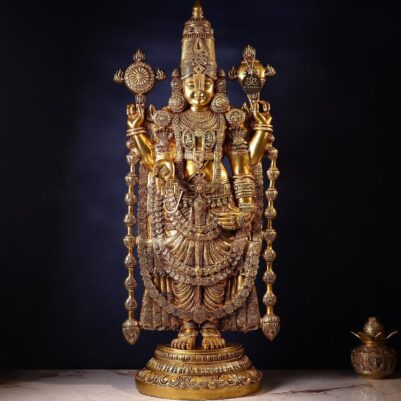
| Brass Tirupati Balaji with stone work | 33 inch | 20.2 kg |
| Panchloha Tirupati Balaji | 48 inch | 43 kg |
Anything over 10 kg needs a strong, flat platform, not a thin wall shelf. To pick the height first, see our murti size guide for the home temple.


Check these before you buy
- The material is written in the product name or description. If it is not clear, ask the seller before you order.
- The weight is given, and your shelf can hold it.
- There are photos of the back and the base, not only the front.
- For stone work or black lacquer coating, the care advice is given.
- For panchdhatu, the seller tells you which metals are used.
Questions people ask about murti material
Is panchdhatu better than brass for pooja?
Both are traditionally used for worship. Panchdhatu is often chosen when the family or the pandit asks for it. For daily pooja at home, a brass murti is just as accepted and is easier to find in every size.
Can I do abhishek on a stone murti?
A little water is fine if you dry it well afterwards. Skip milk, oil and honey, which can stain stone. If daily abhishek is part of your pooja, a brass murti is the easier choice.
Why did my brass murti turn dark?
Plain brass reacts with air and the oil from our hands, so it slowly turns darker. This is normal. A lemon and salt rub brings back the shine. A black lacquer coating is different: it is black on purpose and should only be wiped with a dry cloth.
Is a stone murti heavier than a brass one?
Not always. It depends on the size and the shape. Our 8 inch pink stone Panchmukhi Ganesh weighs 3 kg, while our 7.5 inch antique brass Saraswati weighs about 2.4 kg. Read the weight on each product.
Ghar ke mandir ke liye brass ya stone, kaunsi murti achhi hai?
Agar aap roz jal ya doodh se abhishek karte hain, to brass ki murti sabse aasaan hai. Stone ki murti sundar dikhti hai, par use sookha rakhna hota hai aur nimbu ya polish nahi lagate.
So before you choose the deity’s pose or size, choose the material: think about how your daily pooja goes, and the right murti will be easy to find.


